Friday, 18 January 2019

Winter Scent - Every garden has space for these 2 favourites

Summer flowering plants attract their intended pollinators by being BIG, BLOUSY and COLOURFUL. But with fewer pollinators around, winter flowering plants have to work really hard to attract theirs.  They do this with much smaller flowers with POWERFUL SCENT. 

The Viburnum family has loads to offer, but some varieties can be rather too large for a smaller garden.  There is of course also the sweetly scented Mahonia with it's bright yellow flowers.

The well behaved Witch Hazel (Hamamelis) family, pictured below, has spidery flowers which open  in winter on it's bare stems.  Depending on the variety the flowers come in Yellow, Orange or Red tones.  My yellow flowing Mollis variety flowering now, but orange Jelena, tends to open about a month later.  Witch Hazels offer fabulous autumnal foliage too.

Hamamelis Mollis (Witch Hazel)

But even in the smallest of gardens, there is space for packing a punch with winter scent. Below are two of my favourites, used in many of my client's gardens.

Evergreen Daphne Odora Aureomarginata, is covered in flowers at the moment. A bit of a mouthful, but it all makes sense when broken down . Daphne (the plant genus), Odora (meaning scented), Aureomarginata (meaning a narrow band of yellow on each leaf).

It is sometimes difficult to source, and when I do  find it, it's usually a very young plant, just a few inches high on one stem.  But well worth having, and waiting for it to mature into one of  the most trouble free plants I know. It will grow slowly to around 1.5mtr x 1.2 mtr wide.   I have only ever pruned a few tips just to bush it out a little, after a number of years.   Like all evergreen shrubs, it will shed it's older leaves over the summer, whilst simultaneously sprouting fresh new ones. Mine grows in part shade, but also happy in sun.

Daphne Odora Aureomarginata

My next "must have" plant for winter scent is Sarcococca Confusa.  Also quite a mouthful, but often referred to as the Winter Box.  This is happiest in shade or part shade. It's leaves are a glossy dark green, and the tiny white flower almost insignificant, but there are hundreds of them, and the scent is amazing. I have mine near the front door, and many a visitor has asked "what is that beautiful scent?". A few years old now, I prune mine back by about 1/3 it's size in early spring, just to keep it in its allocated space. It then has almost 9 months to regrow and time for its new shoots to flower the following January.

Sarcococca Confusa flower just opening

Sarcococca - each stem has loads of flowers

 All photos taken in my own garden 18th January.

Don't prune everything too early. You are missing out!

Many gardeners are desperate to cut down all their perennials in the Autumn, getting their garden tidy for winter.  Personally, I only remove the foliage which turns a bit mushy with the first frosts. Otherwise, I leave the stems and seedheads for structure. If we then get a hard winter frost, or even snow, the garden takes on a magical look. So far, in Berkshire this winter, we are yet to experience this, but I still enjoy the rich brown tones and different shapes the seedheads have to offer.

Here is a selection of what I spotted today.

Astrantia Seed Heads
Echinacea

Echinacea

Aster Frikartii

Sedum Gooseberry Fool


Monday, 10 December 2018

How to plan to include a larger than average garden building

PRACTICALITY IS KEY in any garden design. The garden has to work for the owners in whatever way they need to use it. After that, it's a case of making it interesting. This client will soon convert their garage into extra living space, so their number one priority for the garden was a large building (to house all the stuff in the current garage).  They were struggling to know what else to do with the garden.

I was delighted to be contacted by this client, whose sister's garden I had designed over 16 years ago.  This client had watched her sister's garden mature, and now she asked for my expertise to help plan with her own garden.

THE BRIEF

  • Provide space for a large timber building, part bike store, part general storage
That was pretty much it for the client brief, but I could also see some other issues......

  • There was not a great deal of planting, but what there was, was all in shade, so in the height of summer, there was no colour in the garden.  
  • It was difficult to get through the narrow side path of the house to the garden, past various dustbins and recycling boxes. The new shed was to house bikes, so a clear run was a must!  
  • The current patio seating area was directly in front of the living room patio doors. (something I always avoid if possible, since it blocks the view from inside)


THE SOLUTION
  • There are two enormous Oak Trees with TPOs in the neighbouring gardens, so there would always be shade, ( and leaf fall!) however, there was a large sunny area right in the middle of the lawn, for a good few hours each day in summer. My design would make the most of that space, providing colourful planting.
  • In order to give more plants a chance to get established near the tree roots, timber raised beds 20" high, would give the plants a good start, getting their roots established, and maturing to screen the fence.
  •  I suggested a bin / recycling store should also be top priority, so that the side path is clear.
  • Move the main patio space to between the patio doors and kitchen window, therefore the view is no longer blocked from the patio doors. Have a second seating area, outside of the new garden building, offering views back to the house. The central sunny border than can be enjoyed from both sides, and  much more of the garden will be USED, rather than sitting only next to the house wall.
The client is only part way though painting the fences, and the garden building is not yet in place. I will revisit next year, but for now can share how the garden looks after planting today.  (December)

The client was nervous about loosing so much lawn in the design, but I hope now convinced (and certainly by next year when it's full of colour) that they will use and enjoy so much more of the garden now.

(Before photos at the end)

This will be the view looking back from the front of the new building when it arrives.
The gravel channel (drainage) will be the front edge of the building, the paving area in front will be pathway
leading to a small seating area further to the right. The gate on the left is one of two gates giving access to a bin store, and will be painted to match the fencing, and therefore becoming more seamless. (the BBQ will be stored elsewhere)
On the fence, an evergreen Jasmine and a climbing Rose, will clothe the fence.


In the central sunny border, glaucous foliage of Eurphorbia and Dianthus provide evergreen
structure, and will be joined by a range of sun loving plants next spring.

This will be the view from a seating area in front of the new building.  (BBQ storage next to the timber beds.)
View to the right are the shade beds and to the left the sunny border across the centre of the garden.
Next spring, the deciduous shrubs and perennials will completely transform the planting areas. 

Coming into the garden from the side path, a gate (to the right) allows
access to a bin store.

The central sunny border has medium height "see through" planting, including Salvia Caradonna,
which teams up well with silvery Ballotta.  A small Magnolia, Fairy Rose, Sedum, Gypsophilla are amongst other long flowering plants, giving seasonal interest in this sunny border.   In the background, the raised bed for shade plants including
Photinia, Holly, Sarcococca, Ferns, Hellebore and Brunnera

BEFORE.....
BEFORE. The patio barely big enough, and the rest of the garden mostly lawn.
Easy to maintain, but no inspiring to sit  in.

BEFORE. A large sunny area in the centre, but only lawn, and a garden shed

BEFORE. Kitchen window view. The old shed, pretty, but not large enough for the future plans.
Lots of bare fencing, which is never pretty to look at. Focal point is a covered BBQ.

BEFORE. Side path. Difficult to navigate.

Thursday, 25 October 2018

Making the most of a small garden

This client had a beautiful modern kitchen extension with tall windows looking to the garden.  But the view was not so inspiring.  They had recently added two new patio areas, but were still not excited by their garden, so called me in for advise. Planting this late in the year is difficult to give impact so I am  always delighted with a reaction like this, since the garden will look so much better next year.

"My garden was so uninspiring that I didn't like to sit out on the patio even during our extended and glorious summer. Anne has transformed my garden into a beautiful space with texture, colour and interest. I can't wait to show if off to friends and family."  MC

THE BRIEF

  • Make the garden interesting
  • Lose the shed
  • Lose the vegetable beds
  • Lose the small pond (which actually wasn't visible anyway, lost amongst foliage)


THE SOLUTION

  • To provide a "journey" to the garage door via a pathway, leading between planting areas, which also linked the two existing patio areas. (walking between planting areas always makes the garden feel more 3 Dimensional)
  • Provide a new storage area to conceal the dustbin and recycling boxes. Not part of the brief, but I thought essential.
  • Use planting which provides some winter structure, but otherwise plenty of space for seasonal changes. 
Here is the garden just planted yesterday. It will look a lot different next spring.
BEFORE photos at the end.


View from the small existing patio with swing seat. in the far corner, next to the garage door, a gate
leads to a storage area for utility items like bins.On the right, a block of Teucrium Lucidrys, an
evergreen low shrub, which the bees adore when it's pink flowers come next summer.

View from the opposite side, giving access to the bin store and garage door.
The box hedge will accentuate the curve giving good winter structure. Hydrangea Annabelle will spread to
around 1.5metres tall and wide and will put on a good show for months, and is underplanted by spring flowering Brunnera Jack Frost.   This border is north facing, but colour  and texture will be provided near the window by white Astillbe and texture from ferns.

View from the existing patio near the house. 4 Climbers will clothe the fences. Trachelospermum Jasminoides
2 Roses, and Clematis Montana Alba. In the far corner, spring flowering Amelanchier Tree will provide height.
Penstemon do well here, so more were used in the new scheme

Stipa Tenuissima. 3 were used as linking plants across the borders.
Joined in sunshine by Sedum, Echinacea, and Erigeron amongst others.

Caryopteris Dark Knight - a wonderful shrub for late season colour

Astrantia Roma - a pink form which will flower in May-June and again September-October
This is used in two blocks which are in part shade.


BEFORE
A shed past it's best, is the main focal point in the garden.

Vegetable beds with no fence screening. Grass all the way up to house wall

not the best view from the table.
Grass up to the windows, seemed like a lost opportunity.
The new design includes just a few pavers to avoid soil splash back, but brings planting
close the window to be enjoyed from indoors.

Wednesday, 29 August 2018

Looking good for a second time.... Astrantia

I always advise my clients to cut down some of the earlier flowering perennials like Geraniums and  Alchemilla Mollis but also Astrantia, about mid July. This leaves a gap for about 3-4 weeks, but gives them the chance to regrow their foliage so that it's fresh again right into September and October. If you don't trim them, they will look exhausted by the end of July, and let down the freshness of the plants around them.

Astrantia are a large group comprising white, pale pink, and claret coloured flowers. There foliage is excellent for ground cover, so plant in groups of 3-5.  There is even a variegated leaf form. But whatever the variety, the growth habit it the same. They prefer a soil which is reasonably moist,  and are happier in semi shade, although sun is fine so long as kept moist.   And the insects love them too.

Their natural flowering time is early June for a few weeks, until their flowers fade to pale brown and soon begin to set seed. THAT is the time to dead head any brownish looking flowers, then when they have all finished flowering, take some secateurs and cut all the foliage right down to ground level. In a dry summer like we have just had, they need a good drink regularly to recover, but by mid August the foliage will be looking great once more, and they will provide a second flowering lasting into October.

They are really interesting flowers and look amazing close up.Here are a few from my own garden this morning. All in their second flush of flowering.


Sunday, 19 August 2018

A low maintenance approach

This client, a lady living alone, was struggling to keep on top of her garden.

THE BRIEF (very short)

  • Easier to maintain
  • Include a couple of Roses and Fushia
  • Keep the shed
THE SOLUTION
  • I suggested that the large conifer, although providing good screening from the neighbours opposite was dominating the small garden space. It was agreed to get some tree surgeons in to lift the canopy letting in more light, and moisture below it.
  • The lawn was just hard work, so I opted to not include any
  • Providing raised planting areas would make future maintenance much easier, rather than bending down to ground level
Before photos at the end


Nice and easy now to look after! Beds easily reachable whilst standing at the lower level.
A broom is all that's needed now instead of a lawn mower.


 To the left a new bed with fresh soil around the base of the tree should
give the new plants a chance to get established as long as kept watered.

The view from the patio doors will be very colourful for many months. Spring time with Aubretia and Aquilaga, joined later
by Geranium Rozanne, Astrantia Major, Heuchera, Thyme and Climbing Rose. Followed later by Sedum and  Verbena

To the right Daphne Odora will fill out to provide evergreen and beautiful winter scent. Climbing Jasmine
and Honeysuckle with clothe the fence, joined by two Roses, and Astrantia Pink form. Lamium and Gypsolpholla, will tumble over the edges as well as provide good ground cover.

Shrubs along the fence are Euonymus  and Sarcococca Confusa to provide evergreens. Sarcococca is a top
plant for winter scent.There are also 3 Actea plants for late summer scent.

Fushia was also a request. This is Mrs Popple, with a group of Astrantia large
White, which will be back for the second flowering of the year very soon.

Texture under the tree canopy from Lirope Muscari, with Carex Morrowii behind
which will form dense ground cover


Pretty Rose "Mary", a Polyanthus variety which flowers for months if deadheaded.
Its surrounded by Gypsophila plants which will smother the earth next year.


Astrantia in the second flowering of the year

 BEFORE PHOTOS

The tree canopy dominated the garden

There was no definition between lawn and borders

Perennial weeds under the tree. 


Saturday, 18 August 2018

A small garden on a slope

This client's sloping garden had over time become rather dominated by large shrubs, with no space for planting for colour. She hated the view from the kitchen sink. It was of the garden the shed.... He didn't see the problem!

THE BRIEF

  • To improve the view from the kitchen window
  • To improve the horrible local clay (the same as my own garden!).
  • To have a "G&T" patio for evening sun (Top LHS)
  • Water feature?  Maybe.
  • Retain the mature shrub screen along the back fence but reduce the border size, currently full of Ivy
  • Remove the rotting timber retaining walls.
  • Patio not big enough (in my opinion)

THE SOLUTION

  • After some persuasion the gentleman agreed that the shed could be moved to less imposing area of the garden. It could even be reduced in size to 6x4'
  • In order to introduce new soil to the garden, a series of raised beds would give the clients the chance to have plants which enjoyed free draining soil, something they had previously never been able to do. 
  • Using bricks, for the walling, would give the garden a new look, and allow a curve to be introduced in the central area.
  • The G&T spot would mean getting up several steps to the top of the garden
Before photos at the end.

The new view from the kitchen sink.
Plant pots on gravel will  help with drainage after heavy rain
The water feature can be enjoyed from several angles. (low planting will cover the soil by next year)
 With brick walling, I like to use several plants which will tumble over edges to soften the look. These include  Gypsopholla, Osteospernum Jocundum, Stachys, Aubretia, Euphorbia Myrsinities, which will be fabulous by next spring.

The new patio now plenty of space to get around the table.
I wanted to introduce planting between the lawn and the brick wall. I would not normally design such narrow borders, but to make the borders wider on the design, would have got to the point, where it was not worth having lawn.. The plants I used for this solution, which can be kept clipped into shape are Teucrium Lucidrys (in sun), and Buxus (Box) in the shadier part to the right of the above step.


Another raised bed with new soil. The trellis screen has a climbing Rose and a pale yellow Evergreen Jasmine
These will provide a screen to hide the shed in it's new discreet location.
The brick bed above also has Achillea Terracotta, an Orange Shrub Rose, and dark Sedum which looks fabulous with the orange tones.

Verbena Lollipop with Stachys, Sedum Matrona and Echinacea to the left. 7 x Teucrium  to form a small hedge in
the narrowest part of this border.
At the back, under the existing shrubs, the customer has chosen to plant this in time. 

View looking down from the upper patio, passing Lavender on the steps. To the fence side
A climbing Rose and Phlox.  In front of the water feature a group of Erigeron Profusion (tiny white daisy,
will flower for months), and low ground cover so as not to block the view from  Geranium Rozanne.

the whole garden feels much lighter now

At patio level, Spirea Anthony Waterer will screen the electrical points, whilst not breaking if the cable catches it.
Hemerocallis almost finished flowering in August, but loads of colour next year,
and earlier colour  from some Aquilegia in front.

BEFORE
The sunniest part of the garden in the evening covered in overgrown shrubs

The borders looking tired. The timbers rotting

The patio too small

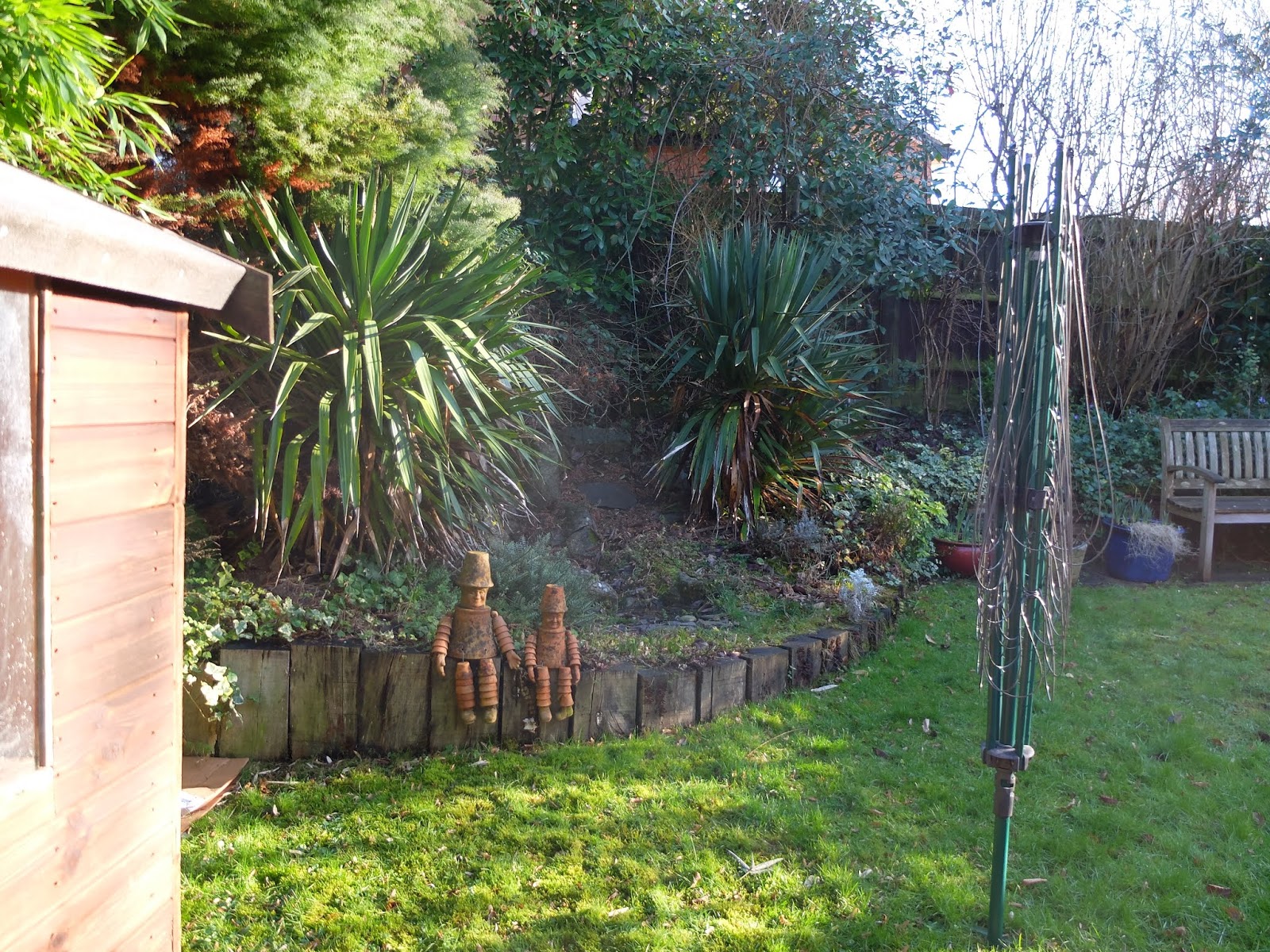
The view from the kitchen sink is a shed